Author Archives: cacklefruit

Hot Damn Zucchini Relish

It’s still full-on summer here, which is great news for condiment-addicted folks like myself.  Never is there a greater opportunity to slather grilled vegetables, meats and other delights in sinfully amazing concoctions, then there is during barbecue season.  I would argue, in fact, that most of what I prepare in the summer is merely a vehicle to transport mustards, relishes, marinades and dressings into my waiting tummy.

To that end I present Hot Damn Zucchini Relish, an infinitely tweakable, locally adaptable colourful topper that makes my mouth water just thinking about it.

Babble-free recipe: Cackle Fruit Hot Damn Zucchini Relish (PDF)

Normally I would do mine with a scotch bonnet pepper, but I acknowledge the fact that searing your esophagus and giggling through capsaicin-induced tears is not everyone’s idea of a good time, so I’ve lowered the heat a bit and changed the flavour by using pre-pickled (guess I’m out of the canners guild…) peperoncini.  If you’re feeling adventurous, give the scotch bonnet a try, but start at a low dose, say half a pepper per batch since these puppies are at least 10x hotter than the hottest jalapeño, which is about 10x hotter than the friendly peperoncini’s used in this version.

In Prep — Your Grocery List

** this relish is actually a semi-negligent two day process.  Day 1 involves the salting, and Day 2 involves the processing, so plan accordingly!

  • 7 medium sized zucchini, either yellow or green or a combination
  • 1 large sweet bell pepper (orange, yellow or red, your choice)
  • 1 large onion
  • 3-4 pickled peperoncini peppers, or any variety of hot pepper depending on your tolerance
  • 1/4 cup pickling or Kosher salt
  • 1 1/4 cup good old white sugar
  • 1 1/2 tsp. each of ground nutmeg and turmeric

This slideshow requires JavaScript.

Chop your zucchini, pepper and onion into small bits and toss them into a big bowl.  If you find texture offensive, finely dice them, but if you’re like me and don’t mind things a little chunky (take that as you may) you can keep the pieces a bit bigger and slightly irregular.  The bowl should look like Carnivale in food form.  The more colourful your mix of raw veggies, the more interesting looking your relish will be.  I tend to use combos of green and yellow zucchini, orange and yellow bell peppers and white onions, though red would be kinda neat as well.  You will be tempted to eat it raw at this point, so delicious is its appearance and crunchy nature.  Resist.  Keep your focus.  Relish, relish, relish.  Sprinkle the chopped veggies with the salt, mix it well, and then just cover up the bowl and throw it into the fridge overnight.

When you take it out the next day, you should see a pool of greenish-yellow liquid that’s been leeched out of the veggies by the salt.  Put the veggies in a colander and press them lightly to wring out as much liquid as possible.  Do NOT mash them to a pulp or your relish will just be an insipid mess.  Put the drained veggies in a pot with the sugar, nutmeg, turmeric, and diced hot peppers and bring to a boil.  Reduce to medium heat and cook until the relish starts to thicken (around 45 mins).  Better to keep the temperature down and take longer during the cooking process than to have the heat too high and end up scorching some of the sugar.  No one likes that taste, especially on a hot dog.

Ladle your creation into jars, follow the standard lock and load canning procedure (post forthcoming in the near future) and process in boiling water for 15 mins.  Keep in a cool spot, like the fridge or cellar, for months, though I’m pretty sure it’s never going to last that long.

Tagged , , , ,

Preserved Meyer Lemons (also works for limes)

Sometimes, in our eagerness to ‘can ALL the things’, we come across recipes that just sound cool, and the pictures are bright and enticing, and although we have no feasible use for the end product, we become fixated not on the practicality, but the pretty. Such was the case with me and preserved lemons. I had to have them, needed them desperately, but in reality had never cooked with them before.

I’m happy to report that I honestly now can’t fathom NOT having at least one jar at my disposal. Like Frank’s Red Hot, I put this shit on anything. If you cook Moroccan, you need this, if you cook any style of Indian, you need this. Seafood? Need it. Stir fry? Need it. Roast veggies? I’m sure you get my point.

The most wonderful thing about it is how bloody easy it is. I am actually fairly confident that chimps, given lemon wedges, salt, and some canning jars, could do this. Salt preserves require no special equipment, and can be prepped in less time than it takes me to brush my teeth.

Here’s what you’ll need:

  • canning jars – I like 250mL for this, especially the short fat ones. Since these are used somewhat sparingly, there’s no need to create 1L vats of lemon.
  • kosher salt
  • 8-10 Meyer lemons – why Meyer? They have a natural sweetness that seriously helps provide a massive burst of lemony flavor in your finished preserves
  • extra lemon juice – fresh squeeze some if you like, or cheat and buy a bottle

Okay, ready for this? It’s super complicated. Sterilize your jars in boiling water as per usual, and thoroughly wash your lemons. I usually cut the knobby ends of the lemons off, but don’t if you’re feeling exceptionally lazy or don’t care about lemon aesthetics. Cut your lemons into eighths. Liberally sprinkle your lemon wedges with salt. You’re halfway done.

Put a layer of salt, enough to cover the bottom, into your sterilized jars. Add a layer of lemons and press them down until they’re mostly juiced. Add another layer of salt. Add another layer of lemon, squish. Repeat until you’ve got lemons packed to within a half inch of the top of your jar. Add one final layer of salt and then add in the extra lemon juice as a gap filler, up to within a quarter inch of the jar rim. Put the lid on tightly and put the jars somewhere out of the way for a weekl at room temp, occasionally inverting them. Then just pop them in the fridge for a couple of weeks and you’re good to go.  The pictures below are with limes.  Don’t get confused because things are green instead of yellow.

This slideshow requires JavaScript.

What To Do With It

This recipe, if left to its own devices, can be like that time in grade school where for arts and crafts they made you make a clay ashtray for your parents, even though neither of them smoked. You were damn proud of your turtle/seashell creation, and your parents murmured approvingly, but it was shuffled awkwardly from bookshelf to bookshelf for a couple months before finding its way into the memento box. Don’t let that happen with your lemons!

First off, these things are potent. We’re talking using one or two wedges per dish. They are intensely lemony and a little salty and if used in too high a dosage, you’ll feel you’re eating a Mr. Clean flavored salt lick. To use them, remove them from their jar and wash them thoroughly. I can’t stress that enough. There will be residual salty flavor even after you do that, and the one time I forgot to rinse, it made the food almost inedibly salty. Rinse, rinse, rinse. I generally discard the inner membrane-y bit. Unlike most lemon items, what you’re really after here is the peel, which should be soft and pliable. For most cooking applications you’re going to want to cut the peel into very small pieces, finely chopped approaching minced. These lemons, or limes if you go that route, will quickly become indispensable in your culinary arsenal. Add as a sort of seasoning…play around, be adventurous (I’m going to try them in some sort of ice cream application). And please tell me if you come up with a crazy combo that works, so I can try it too.

My Suggestions:

  • Fish — either in the oven en papillote or wrapped in foil on the BBQ. Place your filet (salmon or trout are my faves so far) on your foil and drizzle with olive oil. Throw in a small spoonful of capers, and 2 wedges worth of finely chopped lemon, wrap it up and cook over medium heat until the fish flakes when you poke it with a fork. It will smell and taste of angels.
  • Stir fry — beef, chicken, pork, or shrimp, preserved lemon don’t care. Prep your favorite combo as usual, toss in one or two wedges worth with the veggies and you’re golden. Also extremely effective at flavouring rice dishes of all varieties.
  • Roasted root veggies — hack up your favorite combo of tatties, beets, parsnips, whatever, throw them in a pan with olive oil, pepper, and a couple wedges worth of lemon. Oven roast or BBQ with delicious results.

Are they sweet? Salty? Savoury? Acidic? It’s like my tastebuds don’t understand what’s going on, all they know is that they love it and they want more. I recently did a batch of limes and I don’t even have a word for how fucking heavenly these little green creatures are. My next excursion will be using them in alcoholic beverages…just think of the grand dame of Canadian hangover cures: the Caesar, with a thin slice of perversely tasty lime preserve. It might be enough to get me over my aversion to Clamato.

Weird to think of these as a staple food item but I really have grown quite attached to having them around. Hopefully my enthusiasm is contagious.

Based on this Pin:

Tagged , , , , ,

Hhhhh-hi Hhhhh-honey Mustard

A lot of times I wonder if I don’t love food simply because it’s a vehicle to ingest delicious, delicious condiments, particularly condiments of the vinegary variety.  If you were to open my fridge right this very second, and calculate the ratio of sauces:actual food items, your number would be very large.  Mustard is one of my all time favourites.  Everything from the nuclear yellow French’s prepared mustard (which I’m tempted to each with a spoon), to grainy artisan fancy pants moutard.

I found a recipe for roasted garlic-lemon-honey mustard and I thought “now there’s a first date food just waiting to be prepared”, so off I went.  Here’s a concise little PDF of the recipe to help you on your way, or if you refuse to read my meandering commentary:

Cackle Fruit — Hhhhh-hi Hhhhh-honey Mustard (PDF).

Here’s what you’ll need:

Roasted Garlic & Lemon Mustard

INGREDIENTS

  • 3/4 cup dry white wine
  • 3/4 cup mustard seeds
  • 2 – 3 bulbs of garlic
  • olive oil
  • 1 and 1/4 cup white wine vinegar
  • 2 large lemons for both zest (zest first!) and juice  (2/3 cup)
  • 1/4 cup local honey
  • 1/2 tsp Kosher salt
  • garlic powder and dry mustard powder, for adjustments (optional)

Apologies for the “grainy” pictures, it’s not my attempt at a terrible food pun, it’s the last dying gasps of my faithful iPhone.  I promise it’ll get better!  There are basically two main parts to this recipe, which take a bit of time.  The first is soaking your mustard seeds, the second is roasting your garlic.

Seemingly Random Tip #1: Do NOT make this recipe within 24 hours of expecting company at your house.  Roasting 2-3 full hunks of garlic, mashing it, and blending it makes delicious mustard, but a very garlicky kitchen.

Wine is almost completely absorbed.

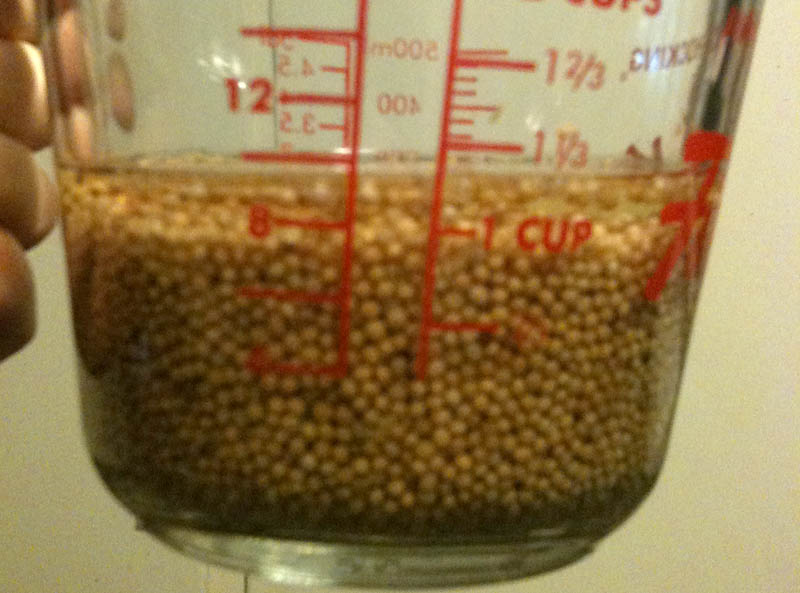
Soaking the mustard seeds can take anywhere from 2 hours to overnight, so if you’re a planner (I’m certainly not) and can predict when you’re going to have the sudden urge to do some canning, combine 1 1/4 cup of dry white wine with 3/4 cups of mustard seeds the day before.  I only had yellow mustard seeds, but for a really neat looking grainy mustard, you can blend yellow and brown.  Like magic, the mustard seeds will slowly absorb the wine.  Let it sit until most of the wine has been soaked up.  I’ve found that it’s usually very close by the time you prep, roast, and cool your garlic and get your lids and jars sterilized.

Garlic, pre-roasting.

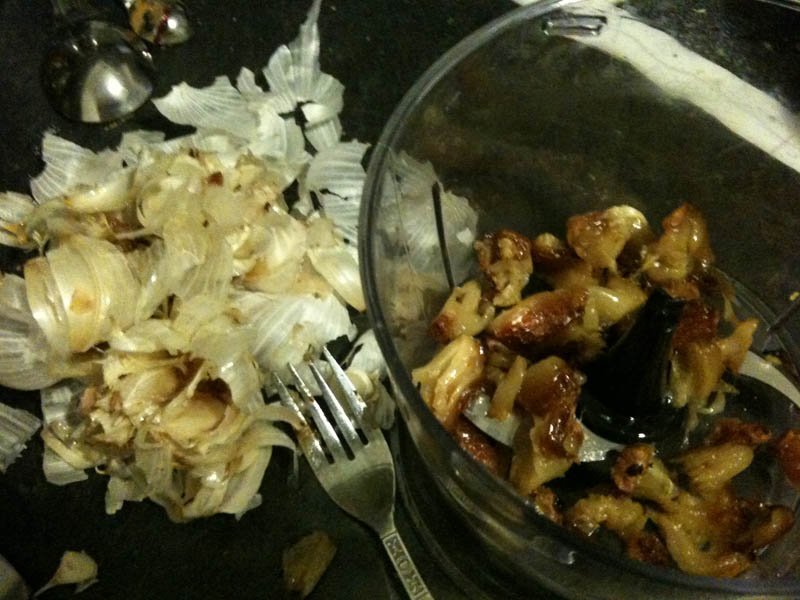
Garlic, post-roasting.

Start in on the garlic by chopping the pointy top off to expose the individual cloves, and then peel as many layers of the skin off the sides as you can without risking structural integrity.  Pop the de-nuded bulbs in an oven-safe dish, drizzle them with just enough olive oil to coat them, and put them in a pre-heated 350F oven.  I like a lot of garlic, so I did 3 whole bulbs rather than 2, but you can adjust according to your own taste.  Roast it for 45 minutes, have a peek.  If it’s gone deliciously dark brown and smells incredibly sexy, it’s good to go.  If not, keep roasting in 15 minute increments until it looks like the post-roasting picture above.  Take it out of the oven and let it cool on the counter for a while before trying to handle it.

The smell really is incredible.

Garlic + Vinegar

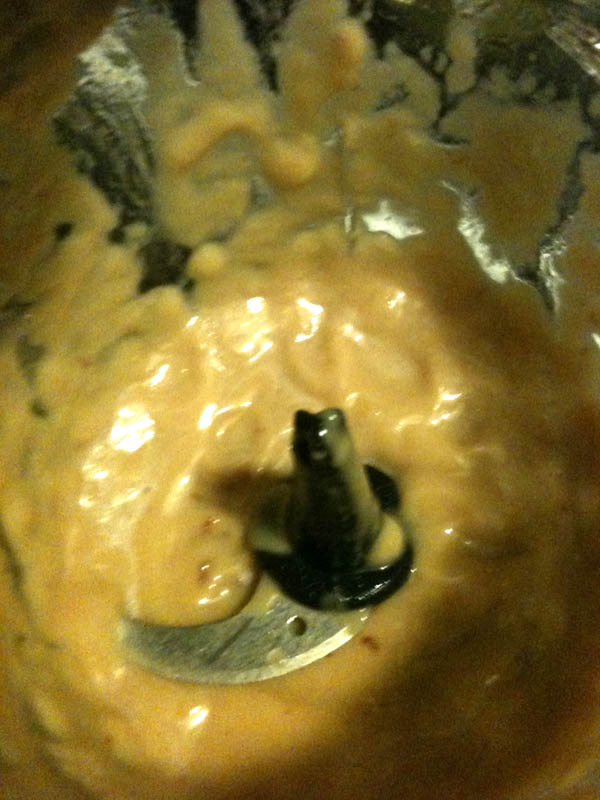
Once it’s cooled enough for you to pick it up, remove each of the cloves and put them in a food processor/blender.  I’ve tried the “squeeze them out like they’re toothpaste” method with decent success, but really the easiest, least messy way to get them out is with a fork.   Add in 1/2 cup of vinegar and blend the garlic into a smooth paste that smells like heaven.  Add in the wine-soaked mustard seeds, 2/3 cup of lemon juice (use fresh lemons and zest them first so that you can use the zest later), 3/4 cup of vinegar and blend to your desired level of graininess.  It’s all about consistency here folks, and it’s an individual thing, so make your mustard the way you want it.  I love whole grain, so I didn’t mangle the poor seeds until they were unrecognizable, but just enough to bust them up a bit.

Pour your almost-mustard into a saucepan, add in the honey and salt, and simmer over medium heat, stirring constantly until it starts to thicken up into something resembling the consistency of French’s mustard. Stir in the zest from those fresh lemons you juiced earlier and cook for another minute or so. Taste it.  If it’s not mustardy enough, you can use some dry mustard powder to spruce it up a bit.  If for some bizarre reason it’s not garlicky enough, you can cheat with a bit of garlic powder.  Not sweet enough? More honey.  I won’t tell.

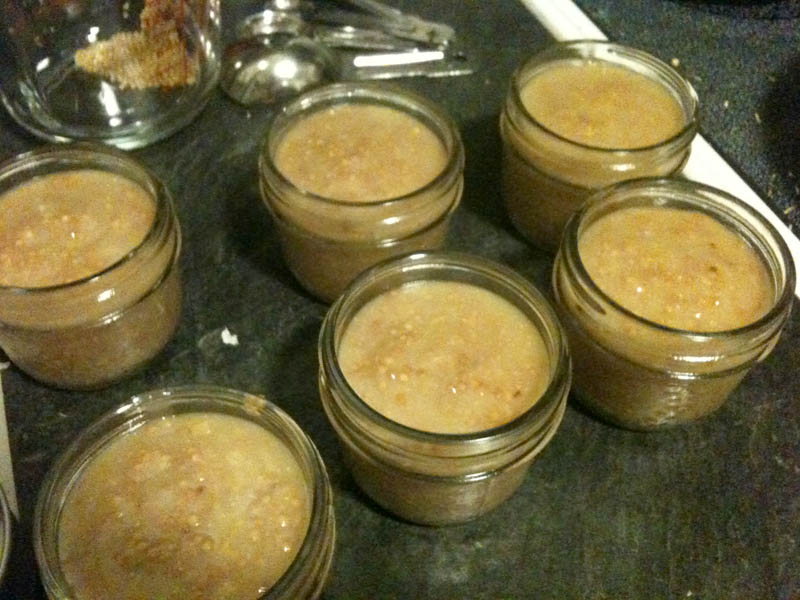
Grainy goodness.

Once it tastes the way you want, fill your sterilized jars, wipe and lid them, and process them in your boiling water canner for 15 minutes.  Remember to take them out at the end without tipping them, and upon cooling you should hear a ‘POP’ as the seal is formed.  If your lid doesn’t have an indent in the middle, it didn’t seal properly, so you’ll have to reprocess that particular jar.  I followed the recipe, used 3 full garlic bulbs and ended up with 6 x 125 jars of awesome.

Original recipe from Pinterest.

Sauerkraut

Cabbage in and of itself doesn’t generally inspire much cheering.  It’s like a mild, massive brussel sprout…most people say the name with a wrinkled nose and memories of odd smelling soups.  Plus it’s awkward to handle and takes up tons of room in your reusable grocery bags. However, it also has the remarkable ability to create several of the most delicious and crack-like edible incredibles in the culinary universe.  One of those is sauerkraut.

Now, coming from a partially-German heritage, I ate surprisingly little sauerkraut growing up.  My earliest memories of it are, in fact, from tentatively placing a few random strands on a some street meat at Union Station.  Somehow, out of that, grew a love bordering more than a little upon unhealthy.  I dream up weird dinners just to be able to eat sauerkraut.  I crave it. I dream about it (not really…).  And then, I found out how easy it was to make.  You don’t even need a fancy ferment crock , all you need are some mason jars, salt, water, and a sharp knife.

Please stop rambling, just give me the recipe.

The Detailed Version

For Those Just Starting Out

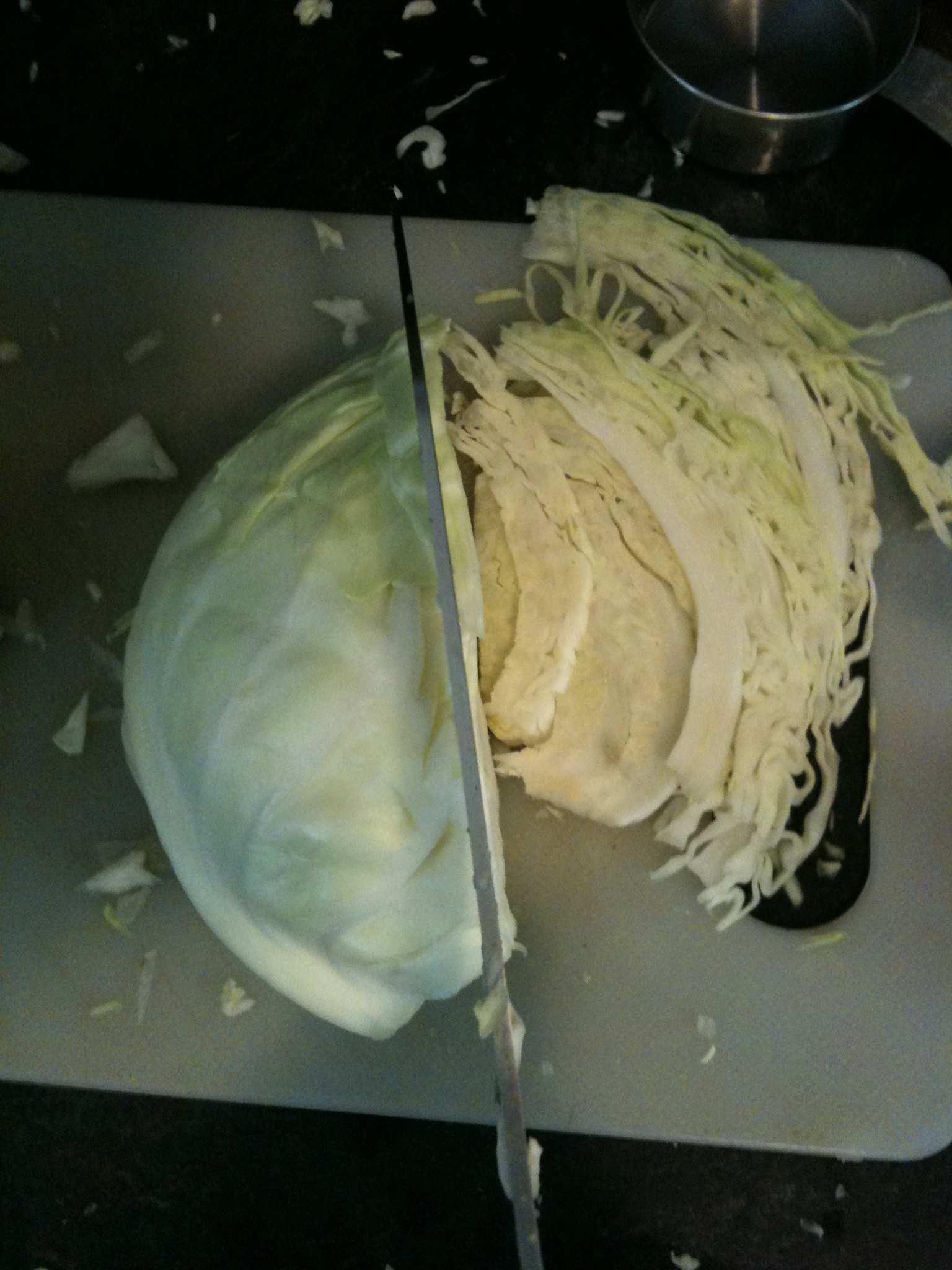
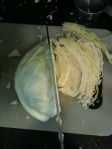
First off, prep your cabbage.  Coring it is not as hard as it looks, just take a sharp paring knife and cut around the core to the full length of the knife, then take a big chef knife and cut your cabbage in half.  You should be able to then just pop out the core from the half of the cabbage.  Peel off the two outer leaves from each half, they tend to be leafy and meh, then peel off the next two leaves on each half and keep them for later.  The colour of the cabbage should have gone from green leaves on the outer layers to a more whitish green colour….perfect for ‘kraut cabbage.
We Don't Need No Stinking Mandolin!

We Don’t Need No Stinking Mandolin!

They will try to tell you that you should use a mandolin to slice your cabbage.  You do not need a mandolin, in fact I prefer not to use one because frankly they kind of scare me and I can see myself removing several fingers in pursuit of the perfectly sliced vegetable.

If you happen to have a mandolin and are proficient in its use, bless your talented soul, but for the rest of us, a sharp knife is more than capable of producing delicately delicious ribbons of cabbage.  See left for proof.

Once your cabbage is razor thin, and provided you still have all your appendages, throw it in a bowl and mash the cabbage with a potato masher. Make it weep.  By breaking it up a bit you’re releasing juices and providing access for the good bugs to the nutrients available to them in the cabbage.  This should get your ferment kick started ASAP. Don’t worry about going to town too much, you can also show your mashing muscles when you pack the cabbage into the jars.  I like to use 1L jars, but then again, I eat a lot of sauerkraut.

Seemingly Random Tip #1:  Mash in a broad-bottomed container to avoid tippage, spillage and general annoyance.

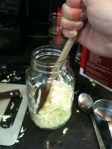
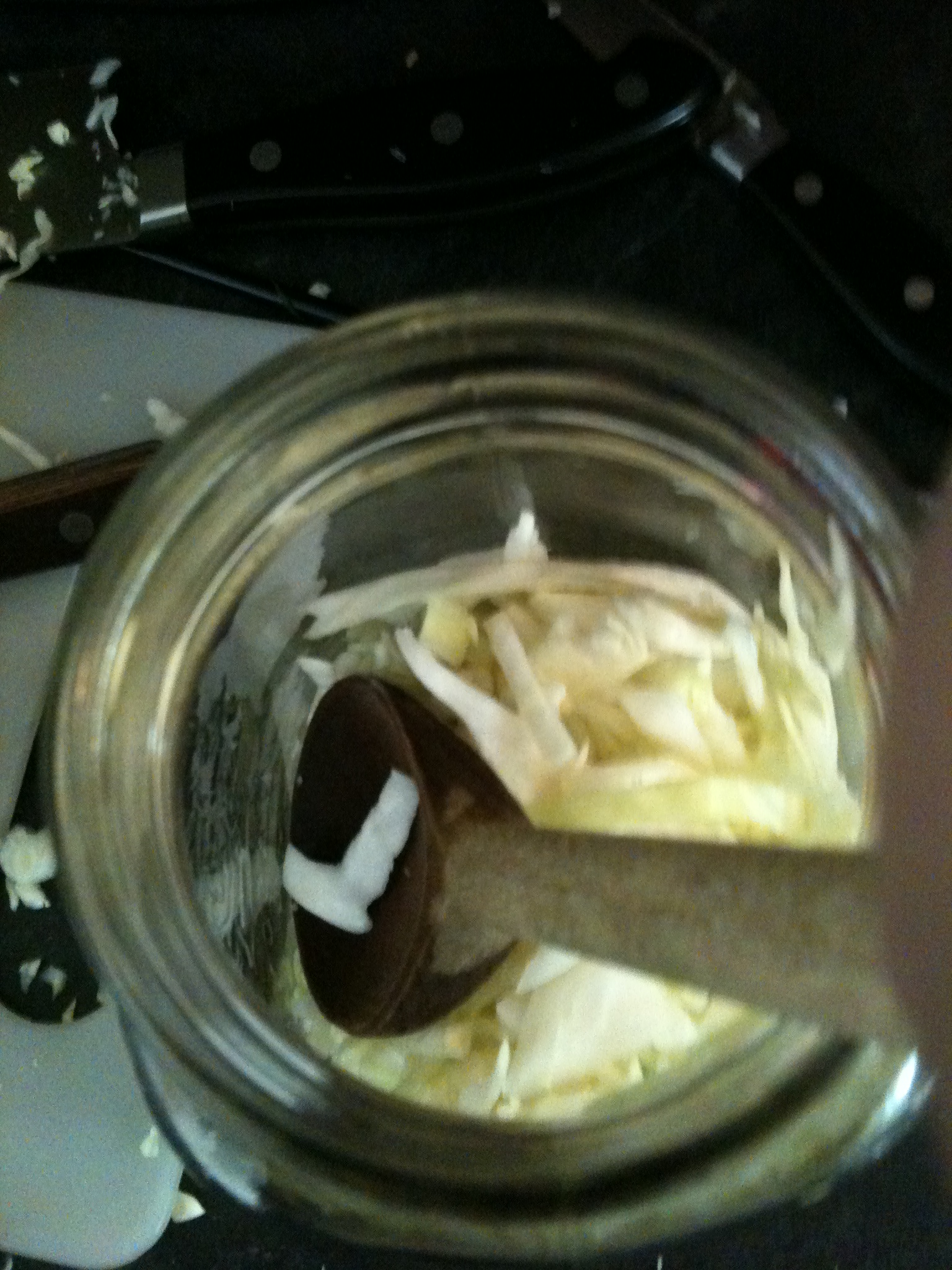
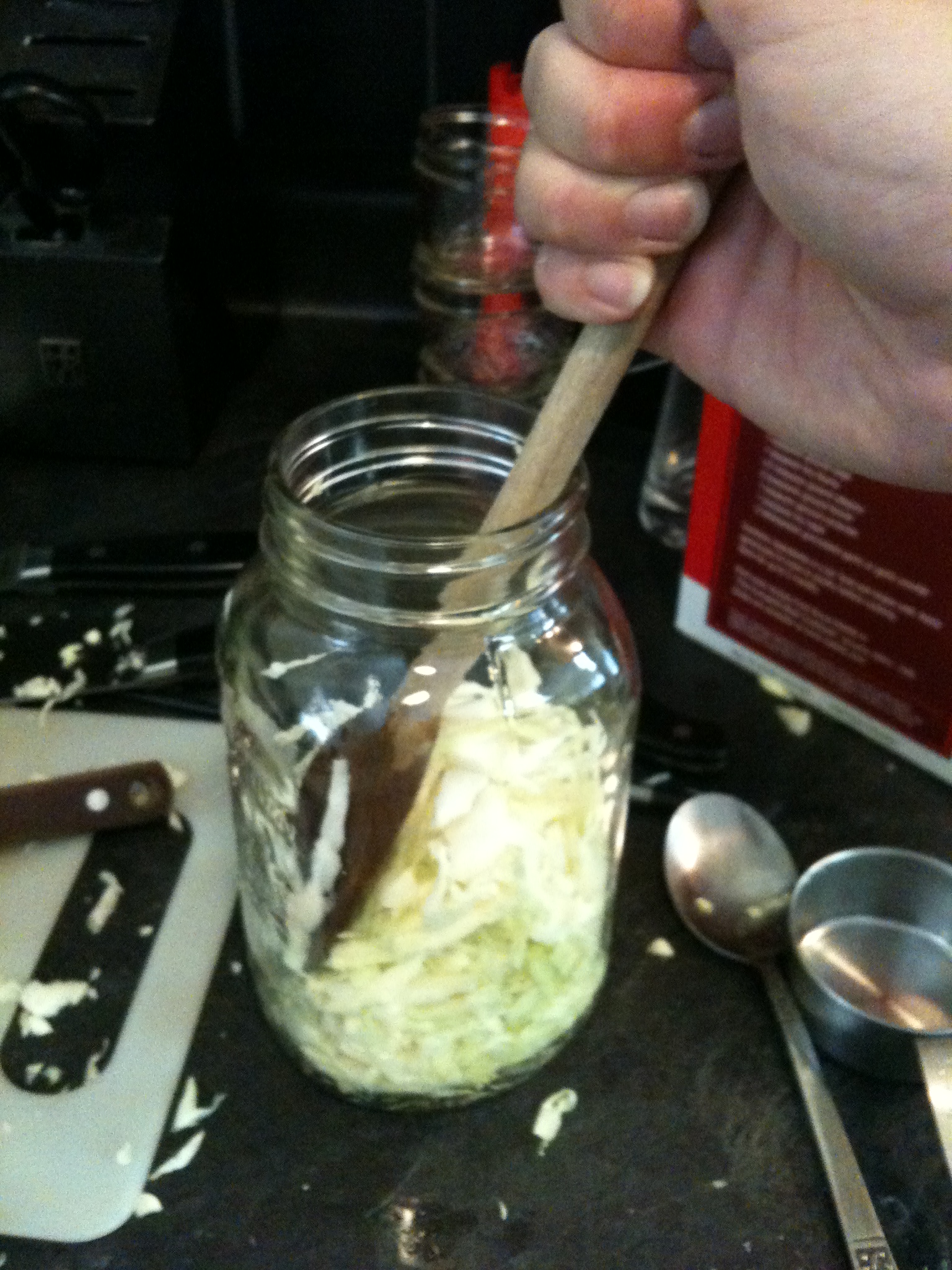
Just how do you pack a jar of sauerkraut?  I would suggest saving it for the end of a terribly upsetting work week because it’s really kind of cathartic.  Boil your jars in your hot water canner while you prep the cabbage to sterilize them; at least 20 mins.  Remove them from the water as needed to pack.  Throw a few small handfuls of cabbage into the bottom of your jar, jam a wooden spoon in so that the convex or “outie” side of the spoon is towards the middle of the jar and press down with the tip of the spoon along the edges of the jar.  The cabbage will squeak, crunch and make other pitiful noises, this is normal.

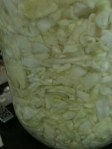
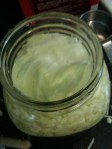
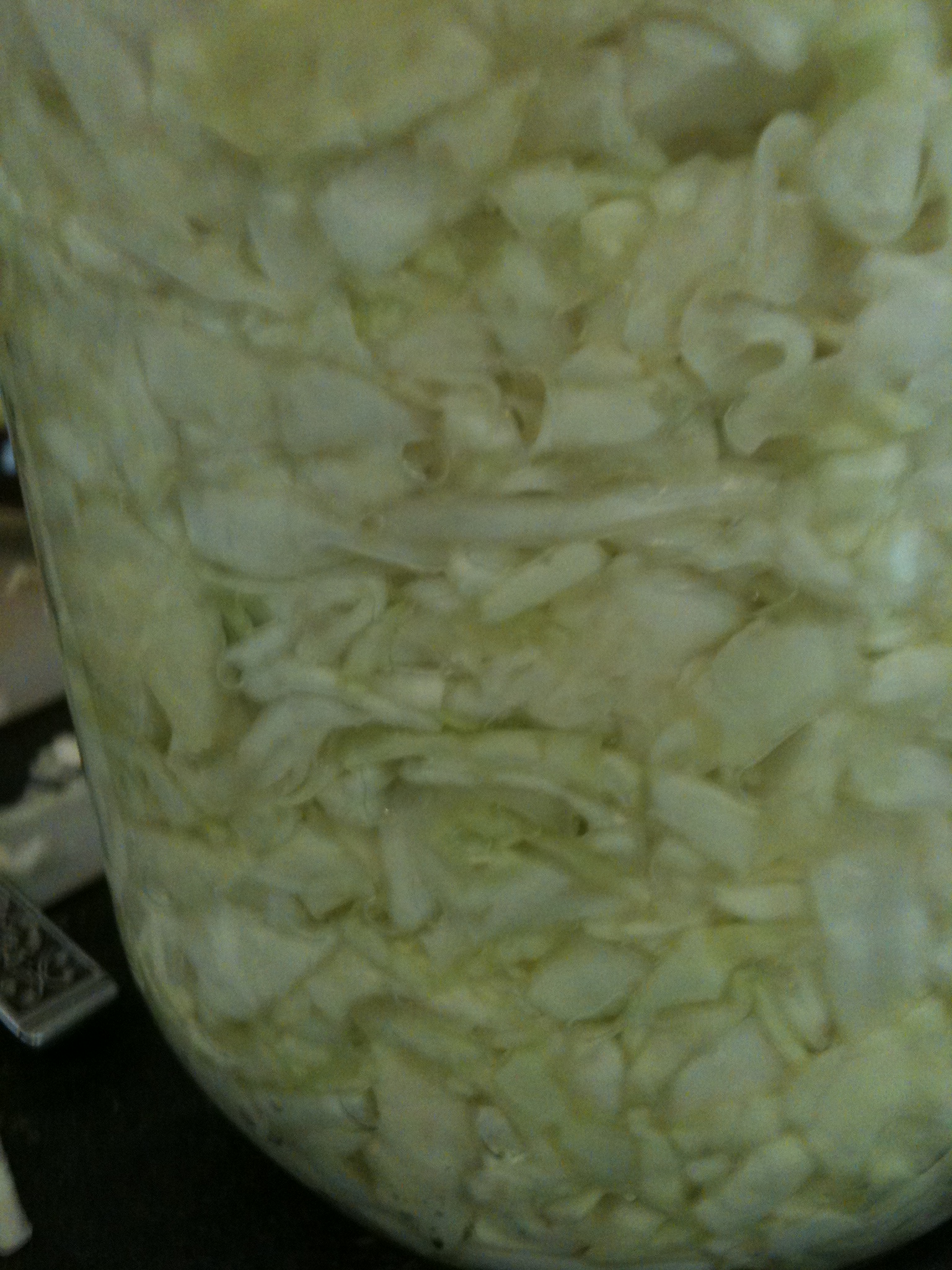
Really push down hard; pretend you’re finally getting that chance you’ve been praying for to grind a fist into the face of your most irritating coworker.  Toss in a few more handfuls of cabbage and repeat until you’ve got it packed so tight that it’s right up to the neck of the collar and hardly moves when you push down on it.  A surprising amount of cabbage will fit in each jar.  In a little measuring cup, dissolve 1 Tbsp of sea salt or kosher salt in 2/3 cup of bottled water.  Don’t use table salt, it tends to be iodized and the bugs don’t like that.  Likewise, use bottled or distilled water if you can because they can get cranky about the chlorine in tap water too.  Carefully pour this brine into your packed jar until it hits the bottom of the collar on the jar.
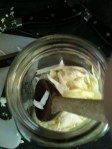
Jam a spoon in and compress the cabbage until you can't compress any more.

Tool use. Like chimps.

Mash, mash, mash, all day long.

See? Spoon down and inwards.

Tightly Packed Cabbage in a Jar

Cabbage Packer Graduate

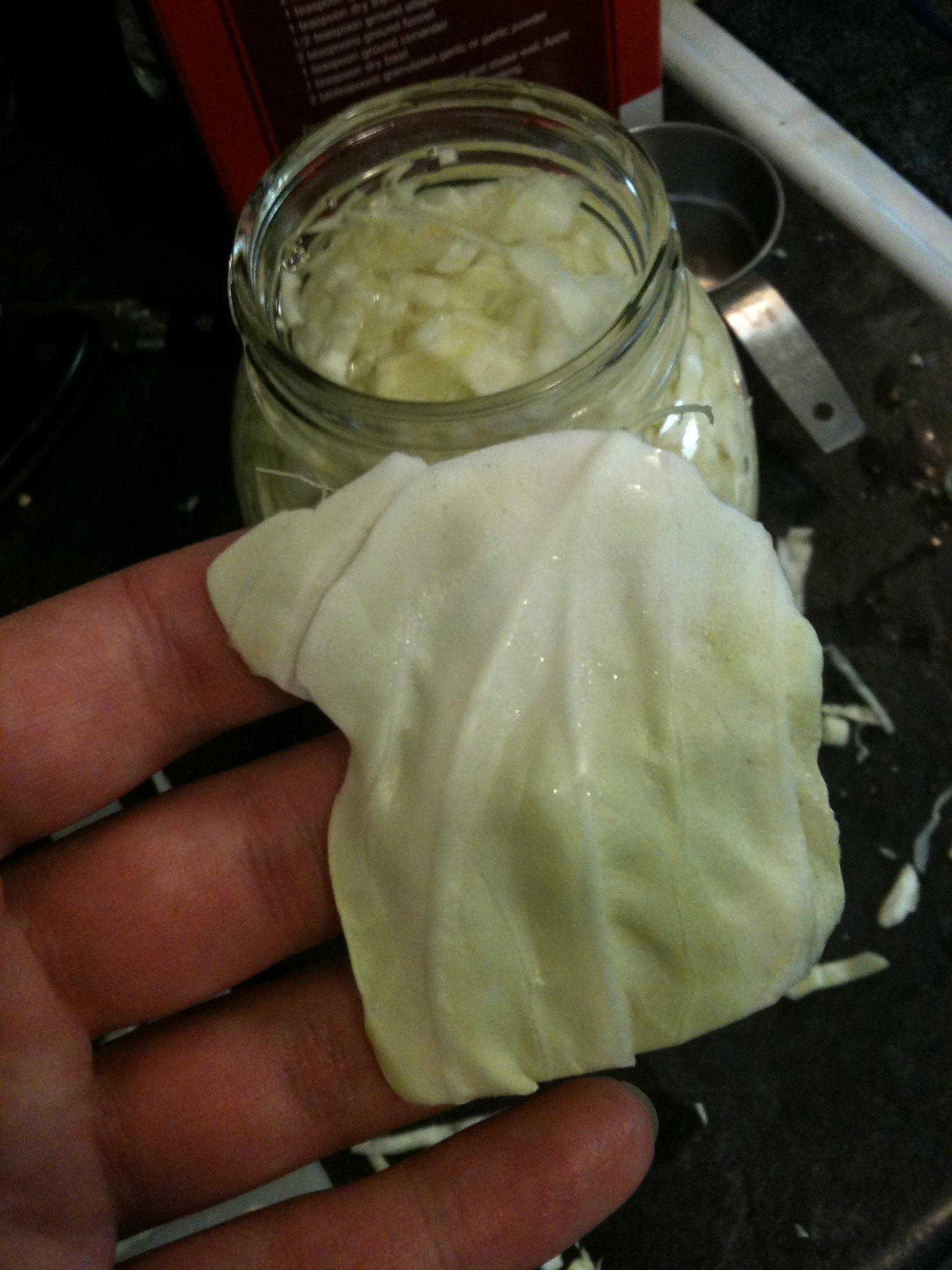
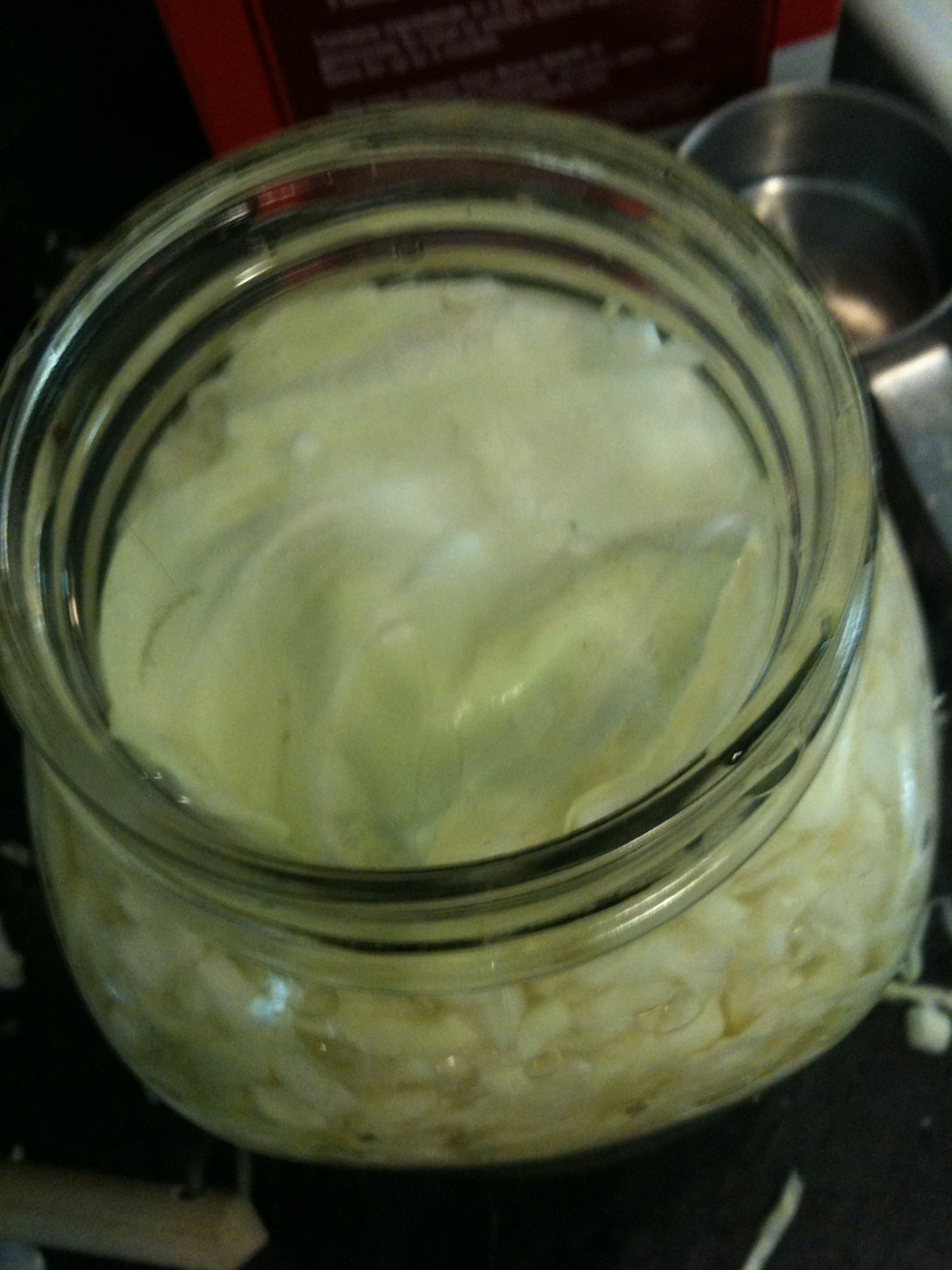
Now remember those two leaves I told you to pull off and keep?  Well grab one, and down by the thick end of the spine, rip of a square that’s bigger than the opening to the jar.  Tuck this into the neck of the jar, into the shoulders, keeping the smaller bits of cabbage from floating up to the top of the jar and being exposed to air.  It helps keep the bloom (moldy bits) under control and doesn’t resort to tactics like sterilized pebbles for weights or elaborate gadgets.  Top up the jar with more water if needed, to within 1/4″ of the rim. No cabbage should be above the water line.
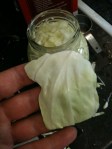
Torn Square of Cabbage

Keep the bits where they belong.

All tucked in for ferment.

Pop the lids on the jars, but don’t screw the rings down tight, essentially just enough so that they won’t fall off or get lost. Place your jars of soon-to-be-sauerkraut somewhere with a nice constant temperature.  Around 15-20°C is great, so I just tuck mine in the corner of the kitchen counter usually reserved for the toaster and miscellaneous junk that I have no home for.  Check your jars every other day, skim off any bloom with a spoon, and if your cabbage leaf cap has come loose or small bits of cabbage are escaping, just re-tuck your leaf and push everything back down.  Top the jar up again with some water to minimize headspace.  Let it ferment until it reaches the tanginess that you like.  I’ve tried everywhere from 3-6 weeks; sauerkraut’s natural acidity gives it a long, safe shelf life if properly prepared.

Seemingly Random Tip #2:  Put your fermenting jars on a tea towel in case of happy-ferment overflow and/or leakage.

Refrigerate it after ferment if you’re going to indulge in the short term, but if you want to process your jars for longer terms storage, boil up some water in your canning cauldron and tighten the lids — but don’t crank them on there, ‘just until you meet resistance’, say all of the books.  Put your jars in the canner upright and make sure the water covers the top of the jars.  Leave to boil for 20 mins.  Remove with your handy dandy jar lifter without tipping or tilting, and set it on the cupboard.  Don’t even think about touching or tightening the lid ring.  I will know.  And I will be disappointed in you.  As the jar cools, the lid will form a vacuum seal with the jar and you should hear an audible pop when the middle of the lid gets sucked in.  Leave them on the counter for about 24 hours, check all the lids to make sure they have the indent (meaning they sealed), just like when you buy jam and stuff at that grocery store, remove the lid rings, or tighten them right down and then store the jars in a cool, dry place.

If you’re curious about sauerkraut and the nifty ferment process behind it, you can find out a bit more about lacto-fermentation and the cool bugs that turn your cabbage into ‘kraut.  Here’s a primer: Wikipedia ‘Sauerkraut’


TL;DR!

For those of you who don’t need the step by step and just want the quick’n’dirty on this recipe, click here to download a short form recipe PDF: Cackle Fruit — Sauerkraut (PDF).


What To Do With It

Now that you have these jars of fermented awesome and you stand, bearing your wooden packing spoon like some sort of badge of honour, you may be struck with the horrible realization that you don’t know what to do with Sauerkraut.  Clearly you are not German.  This is okay, I’m here to help.

  • simmer some sausage.  Preferably Oktoberfest style, but really any sausage will do. Toss in some ‘kraut and cook it down until it’s kind of flaccid and pungent. Trust me it’s the best late night snack ever.
  • top your dogs.  Like the street meat vendors in every big city, you too can now drape your hot dog in tangy layers of cabbagy goodness.
  • slow cook it.  Throw a cup of chicken stock or wine in the bottom of  slow cooker, put a ham in it, cut side down, layer in some potatoes and krautie.  Set it on low, and forget about it for the duration of the workday, only to come home to the most delicious smell.  Instant pick-me-up.

Variations To Try

Here are some suggested alternatives to straight old cabbage’n’brine, try tossing in a teaspoon or so of:

  • Caraway seeds
  • Fennel seeds
  • Mustard seeds
  • Pickling spice mix
Tagged , , ,

Cackle Fruit: The Etymology of an Idea

I have a thing for jars. Actually jars, bottles, and containers of any sort.  I can remember standing in my grandmother’s pantry as a little kid, fascinated by the rows and rows of multi-coloured, exotic looking Mason jars and thinking “where does one get such magical things??”.  This belief in the occult nature of food preservation persisted well into my 20’s and though the sciences behind it (and retail locations to buy those awesome jars), were no longer a mystery, there still existed this aura of awe and unease.

Then, with a stroke of miraculous fortune, I simultaneously moved out into farm country and began working in the wine industry, which happily stripped away the glossy veneer of glamour that wine consumers are force fed with every advertisement, and revealed a messy, mucky, tasty, wonderful process that wasn’t a thing to be feared, but to be adored and celebrated.  Most winemakers are also obsessed with food – it’s only natural – so it was only a matter of time before I met people who canned, jammed, sauced, stewed, fermented and devoured pretty much anything that Mother Nature had, in her good grace, seen fit to offer.

Since my first batch of hideous blueberry jam (over-boiled, solidified into rock candy in the jars) years ago, my affection for homemade goodies has grown exponentially.  I was shocked to learn how easy canning, preserving, and fermenting were and amazed that more people weren’t putting their impressive talents to use creating incredible edibles. This blog, which has been in the works for a very long time, will track and share my (mis)adventures both for my own enjoyment and also with the aim of inspiring others to start “putting up”.

Cackle Fruit  /ˈkakəl/ /fro͞ot/  n. :  Pirate slang for a chicken egg.

Tagged , , ,