Cabbage in and of itself doesn’t generally inspire much cheering. It’s like a mild, massive brussel sprout…most people say the name with a wrinkled nose and memories of odd smelling soups. Plus it’s awkward to handle and takes up tons of room in your reusable grocery bags. However, it also has the remarkable ability to create several of the most delicious and crack-like edible incredibles in the culinary universe. One of those is sauerkraut.
Now, coming from a partially-German heritage, I ate surprisingly little sauerkraut growing up. My earliest memories of it are, in fact, from tentatively placing a few random strands on a some street meat at Union Station. Somehow, out of that, grew a love bordering more than a little upon unhealthy. I dream up weird dinners just to be able to eat sauerkraut. I crave it. I dream about it (not really…). And then, I found out how easy it was to make. You don’t even need a fancy ferment crock , all you need are some mason jars, salt, water, and a sharp knife.
Please stop rambling, just give me the recipe.
The Detailed Version
For Those Just Starting Out
First off, prep your cabbage. Coring it is not as hard as it looks, just take a sharp paring knife and cut around the core to the full length of the knife, then take a big chef knife and cut your cabbage in half. You should be able to then just pop out the core from the half of the cabbage. Peel off the two outer leaves from each half, they tend to be leafy and meh, then peel off the next two leaves on each half and keep them for later. The colour of the cabbage should have gone from green leaves on the outer layers to a more whitish green colour….perfect for ‘kraut cabbage.
We Don’t Need No Stinking Mandolin!
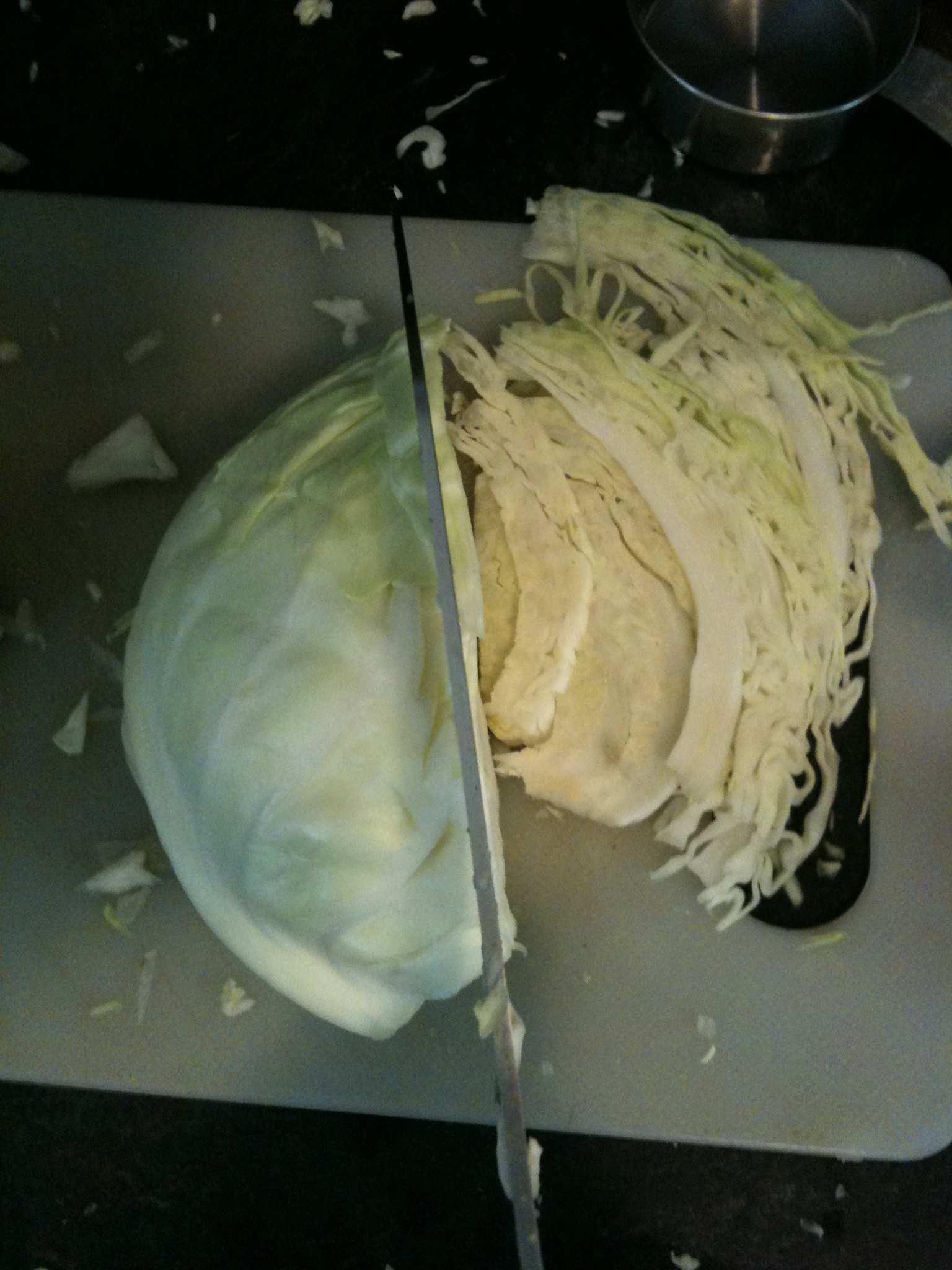
They will try to tell you that you should use a mandolin to slice your cabbage. You do not need a mandolin, in fact I prefer not to use one because frankly they kind of scare me and I can see myself removing several fingers in pursuit of the perfectly sliced vegetable.
If you happen to have a mandolin and are proficient in its use, bless your talented soul, but for the rest of us, a sharp knife is more than capable of producing delicately delicious ribbons of cabbage. See left for proof.
Once your cabbage is razor thin, and provided you still have all your appendages, throw it in a bowl and mash the cabbage with a potato masher. Make it weep. By breaking it up a bit you’re releasing juices and providing access for the good bugs to the nutrients available to them in the cabbage. This should get your ferment kick started ASAP. Don’t worry about going to town too much, you can also show your mashing muscles when you pack the cabbage into the jars. I like to use 1L jars, but then again, I eat a lot of sauerkraut.
Seemingly Random Tip #1: Mash in a broad-bottomed container to avoid tippage, spillage and general annoyance.
Just how do you pack a jar of sauerkraut? I would suggest saving it for the end of a terribly upsetting work week because it’s really kind of cathartic. Boil your jars in your hot water canner while you prep the cabbage to sterilize them; at least 20 mins. Remove them from the water as needed to pack. Throw a few small handfuls of cabbage into the bottom of your jar, jam a wooden spoon in so that the convex or “outie” side of the spoon is towards the middle of the jar and press down with the tip of the spoon along the edges of the jar. The cabbage will squeak, crunch and make other pitiful noises, this is normal.
Really push down hard; pretend you’re finally getting that chance you’ve been praying for to grind a fist into the face of your most irritating coworker. Toss in a few more handfuls of cabbage and repeat until you’ve got it packed so tight that it’s right up to the neck of the collar and hardly moves when you push down on it. A surprising amount of cabbage will fit in each jar. In a little measuring cup, dissolve 1 Tbsp of sea salt or kosher salt in 2/3 cup of bottled water. Don’t use table salt, it tends to be iodized and the bugs don’t like that. Likewise, use bottled or distilled water if you can because they can get cranky about the chlorine in tap water too. Carefully pour this brine into your packed jar until it hits the bottom of the collar on the jar.
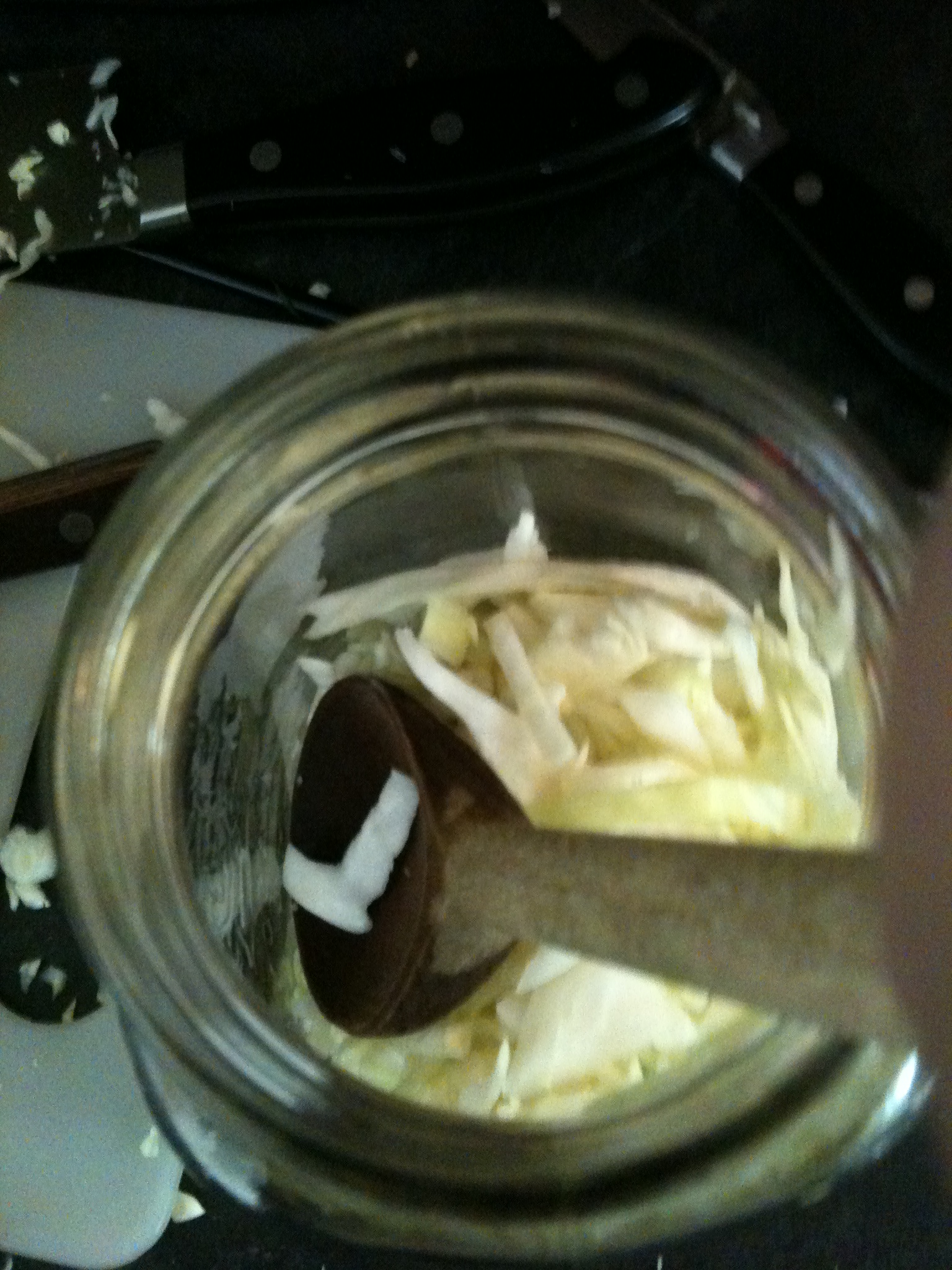
Tool use. Like chimps.
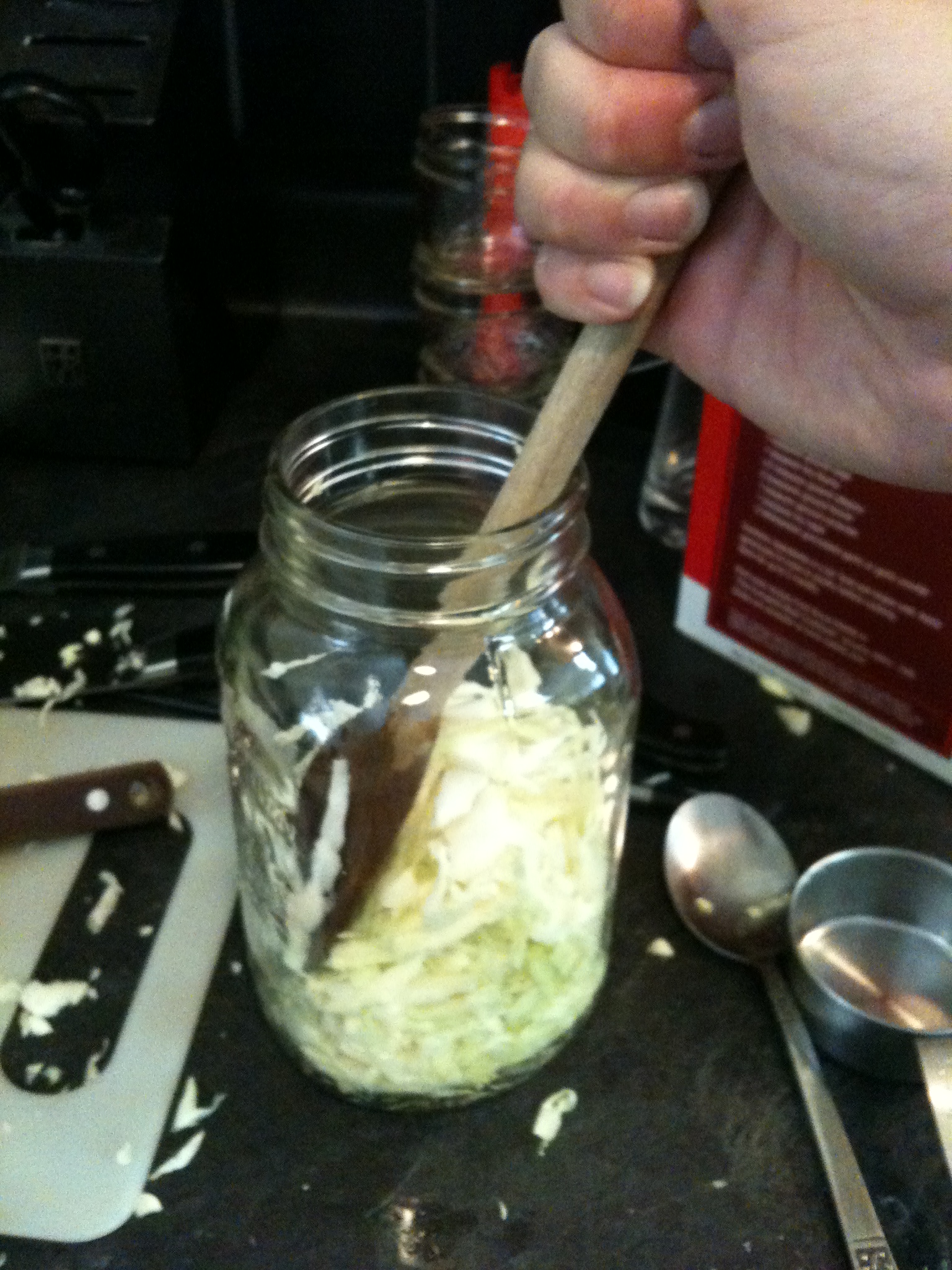
See? Spoon down and inwards.
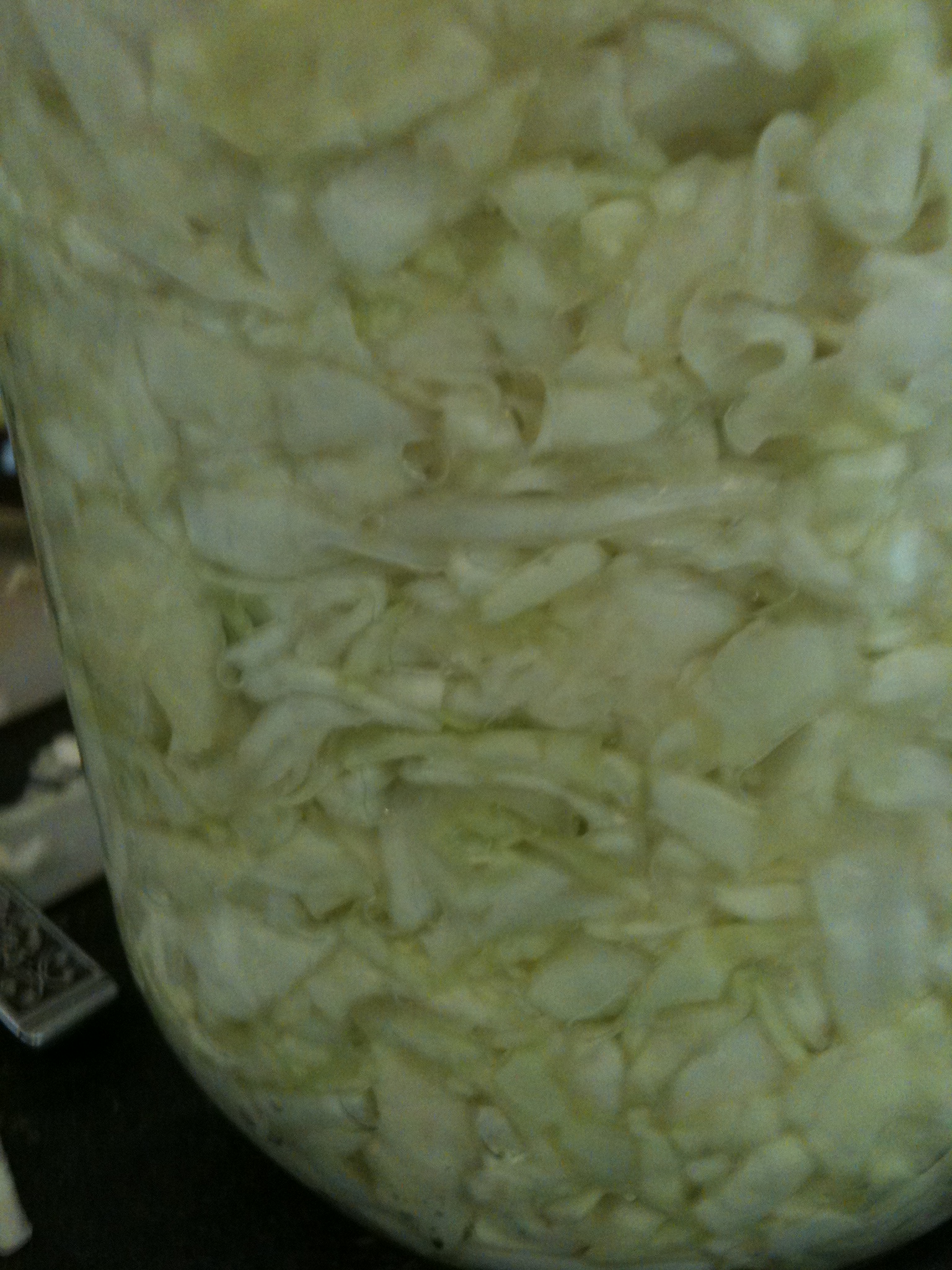
Cabbage Packer Graduate
Now remember those two leaves I told you to pull off and keep? Well grab one, and down by the thick end of the spine, rip of a square that’s bigger than the opening to the jar. Tuck this into the neck of the jar, into the shoulders, keeping the smaller bits of cabbage from floating up to the top of the jar and being exposed to air. It helps keep the bloom (moldy bits) under control and doesn’t resort to tactics like sterilized pebbles for weights or elaborate gadgets. Top up the jar with more water if needed, to within 1/4″ of the rim. No cabbage should be above the water line.
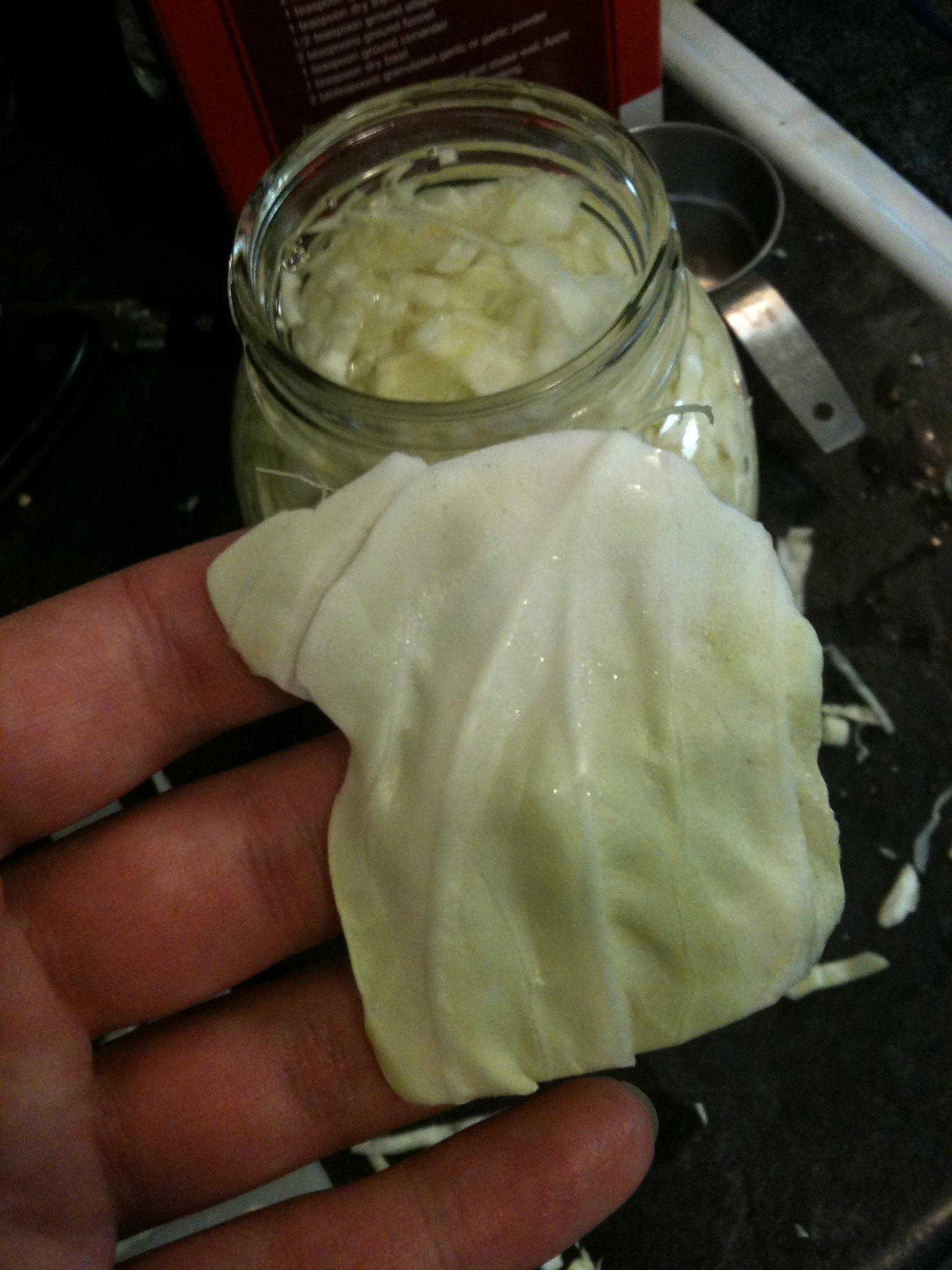
Keep the bits where they belong.
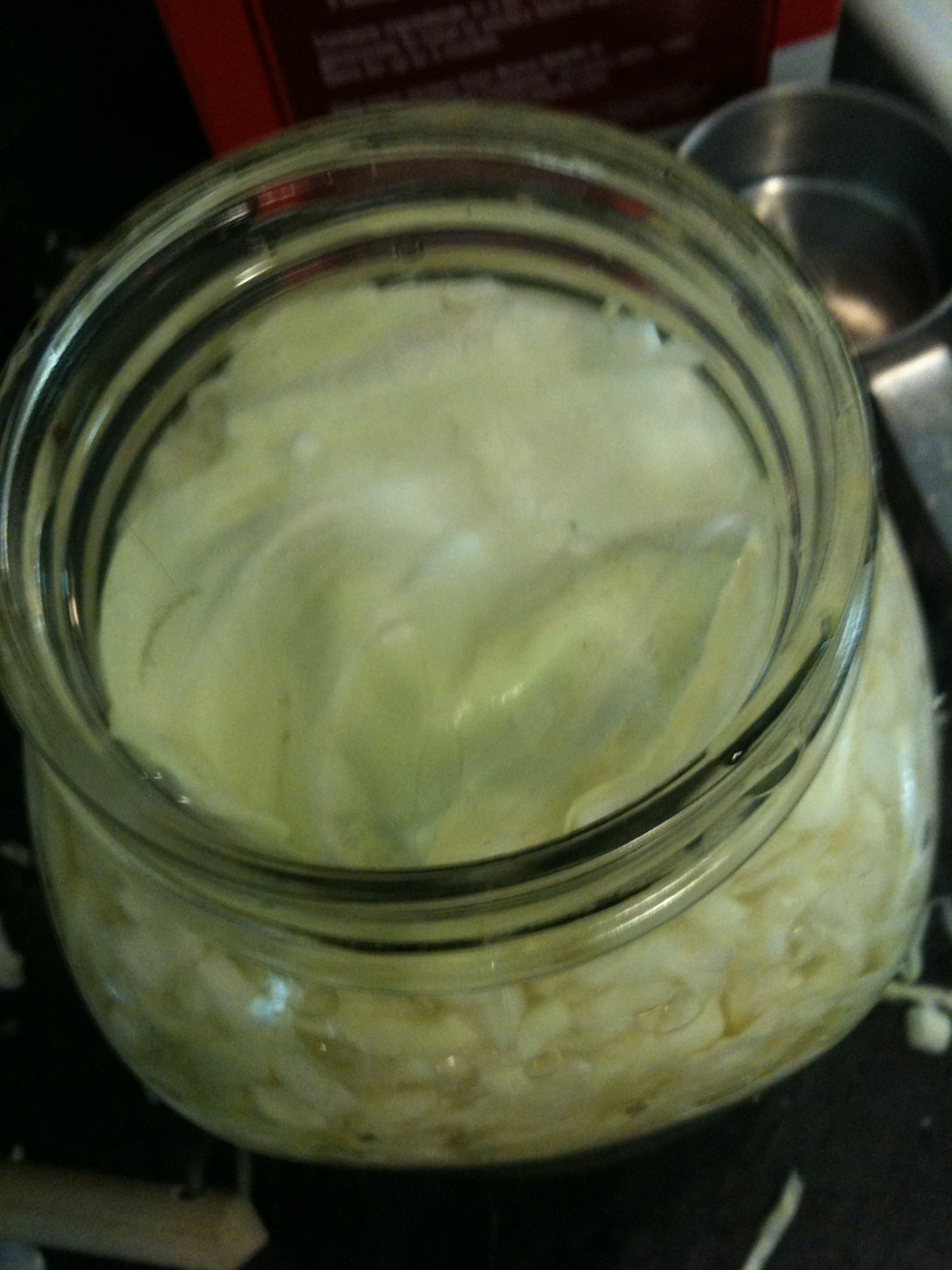
All tucked in for ferment.
Pop the lids on the jars, but don’t screw the rings down tight, essentially just enough so that they won’t fall off or get lost. Place your jars of soon-to-be-sauerkraut somewhere with a nice constant temperature. Around 15-20°C is great, so I just tuck mine in the corner of the kitchen counter usually reserved for the toaster and miscellaneous junk that I have no home for. Check your jars every other day, skim off any bloom with a spoon, and if your cabbage leaf cap has come loose or small bits of cabbage are escaping, just re-tuck your leaf and push everything back down. Top the jar up again with some water to minimize headspace. Let it ferment until it reaches the tanginess that you like. I’ve tried everywhere from 3-6 weeks; sauerkraut’s natural acidity gives it a long, safe shelf life if properly prepared.
Seemingly Random Tip #2: Put your fermenting jars on a tea towel in case of happy-ferment overflow and/or leakage.
Refrigerate it after ferment if you’re going to indulge in the short term, but if you want to process your jars for longer terms storage, boil up some water in your canning cauldron and tighten the lids — but don’t crank them on there, ‘just until you meet resistance’, say all of the books. Put your jars in the canner upright and make sure the water covers the top of the jars. Leave to boil for 20 mins. Remove with your handy dandy jar lifter without tipping or tilting, and set it on the cupboard. Don’t even think about touching or tightening the lid ring. I will know. And I will be disappointed in you. As the jar cools, the lid will form a vacuum seal with the jar and you should hear an audible pop when the middle of the lid gets sucked in. Leave them on the counter for about 24 hours, check all the lids to make sure they have the indent (meaning they sealed), just like when you buy jam and stuff at that grocery store, remove the lid rings, or tighten them right down and then store the jars in a cool, dry place.
If you’re curious about sauerkraut and the nifty ferment process behind it, you can find out a bit more about lacto-fermentation and the cool bugs that turn your cabbage into ‘kraut. Here’s a primer: Wikipedia ‘Sauerkraut’
TL;DR!
For those of you who don’t need the step by step and just want the quick’n’dirty on this recipe, click here to download a short form recipe PDF: Cackle Fruit — Sauerkraut (PDF).
What To Do With It
Now that you have these jars of fermented awesome and you stand, bearing your wooden packing spoon like some sort of badge of honour, you may be struck with the horrible realization that you don’t know what to do with Sauerkraut. Clearly you are not German. This is okay, I’m here to help.
- simmer some sausage. Preferably Oktoberfest style, but really any sausage will do. Toss in some ‘kraut and cook it down until it’s kind of flaccid and pungent. Trust me it’s the best late night snack ever.
- top your dogs. Like the street meat vendors in every big city, you too can now drape your hot dog in tangy layers of cabbagy goodness.
- slow cook it. Throw a cup of chicken stock or wine in the bottom of slow cooker, put a ham in it, cut side down, layer in some potatoes and krautie. Set it on low, and forget about it for the duration of the workday, only to come home to the most delicious smell. Instant pick-me-up.
Variations To Try
Here are some suggested alternatives to straight old cabbage’n’brine, try tossing in a teaspoon or so of:
- Caraway seeds
- Fennel seeds
- Mustard seeds
- Pickling spice mix
 Cackle Fruit